

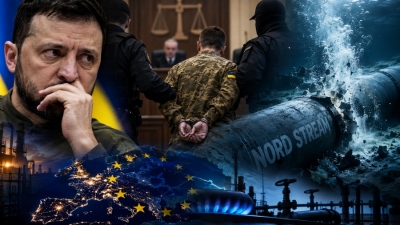
The start of the trial in Germany concerning the sabotage of the Nord Stream natural gas pipelines brings back to center stage a case laden with grave geopolitical and energy implications, placing Ukraine and Volodymyr Zelensky in a difficult position. In the dock of the Hamburg court sits a 50-year-old former officer of the Ukrainian intelligence services, who is accused by German authorities of participating in the operation that ruptured the Nord Stream 1 and 2 pipelines. He denies any involvement, while the judicial proceeding is expected to re-focus attention on questions surrounding the Ukrainian footprint in the case and the consequences of the sabotage for Europe's energy security.
Trial begins in Germany
A former officer of the Ukrainian military, whom German authorities accuse of leading the team of saboteurs that blew up Russia's Nord Stream pipelines, is scheduled to stand trial on Wednesday in Hamburg. Specifically, Serhii Kuznietsov will appear before judges in the northern German city, facing charges of causing an explosion, property destruction, and complicity in war crimes. The 50-year-old former intelligence officer held the rank of captain in the Ukrainian armed forces at the time of the detonations, which severed the seabed pipelines Nord Stream 1 and 2, owned by Russia. It constituted one of the boldest acts of sabotage in Europe since World War II. However, Kuznietsov denies participating in the plot.
Ukraine exposed
The attack dramatically highlighted Europe's reliance on Russian energy, particularly Germany's, as both pipelines terminated on its territory. Berlin's pivot away from Russian imports following the invasion of Ukraine left it dependent on costlier alternative supply sources. Initial suspicions regarding the attack turned toward the Kremlin, despite the fact that the explosions inflicted severe financial damage on the largest shareholder and primary beneficiary of the pipelines, Russian energy giant Gazprom. Since then, however, evidence pointing toward potential involvement by Ukrainian intelligence services has steadily mounted, pointing to an operation described by German police as highly professional and perilous.
What happened to the Nord Stream pipelines
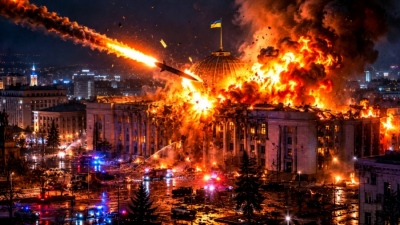
Investigators assess that a team of divers worked through the night, utilizing a small rented sailboat, to place military-grade explosives on the pipelines at a depth of 80 meters beneath the surface of the Baltic Sea, near the Danish island of Bornholm. Three out of the four pipelines across both systems suffered ruptures from the detonations. The resulting explosions released gases with a climate impact equivalent to 15 million tons of carbon dioxide, according to scientific estimates. That volume corresponds roughly to one-third of Denmark's annual emissions. Marine life within a four-kilometer radius of the blast site was likely killed by the explosions, according to an assessment published in the scientific journal Nature.
Seven suspects in the incident
Kuznietsov is so far the only one among seven suspects sought by German police who is set to be held accountable before justice. Prosecutors continue to refer to him publicly only as "Serhii K." However, his full name was disclosed during his extradition proceedings in Italy last year, where he was arrested by police while on vacation with his family. A second Ukrainian, Volodymyr Zhuravlyov, a trained diver, is expected to be extradited from Croatia to Germany shortly. Last year, a Polish court ruled that Zhuravlyov could not be extradited to Germany due to a lack of evidence against him. In a strongly worded decision, the judge in that case argued that even if evidence existed, Ukraine held the right to strike Russian targets, including pipelines, under the rules of war following Moscow's "bloody and genocidal" assault against it.
Criticism against Germany
Poland ranks among the nations offering the sharpest criticism of German judicial actions targeting Ukrainian suspects. Berlin, which otherwise serves as Ukraine's largest backer in Europe, has on occasion found itself in an uncomfortable position due to the case. The German government has repeatedly been forced to emphasize that it exercises no control over prosecutors or the judicial process. For many proponents of a hardline stance against Russia, the Nord Stream pipelines stood as the ultimate symbol of European policy naivety in relations with the Kremlin. They piped cheap Russian natural gas directly to Germany, bypassing Ukraine and Poland.
The pipelines had been vigorously championed by former Chancellor Gerhard Schröder, an ally of Russian President Vladimir Putin, who later joined the board of directors of Russian oil group Rosneft. Nord Stream 1, in which Gazprom held a majority stake alongside four European energy firms acting as minority shareholders, entered operation in 2011. By 2022, it covered more than 15% of Europe's annual natural gas imports. Schröder's successor, Angela Merkel, did not oppose the expansion of the system with two additional pipelines, even following Putin's annexation of the Ukrainian peninsula of Crimea in 2014. Europe's reliance on cheap Russian gas grew steadily, even as Ukraine remained increasingly exposed to Russian energy coercion. It is noted that Nord Stream 2 is wholly owned by Gazprom and was never commissioned. Although fully operational, its certification process was suspended following the launch of Russia's full-scale war in Ukraine.
www.bankingnews.gr



Σχόλια αναγνωστών